
Food Fraud in Meat Manufacturing: Why a HACCP Plan Alone Will Not Detect It
A HACCP plan assumes hazards occur without intent; food fraud is a hazard committed with intent and for profit. This guide sets out documented cases from five regions, explains the difference between HACCP, TACCP and VACCP, and shows what a meat plant needs in place to detect fraud before it reaches the consumer.
In November 2012 the Food Safety Authority of Ireland sent twenty-seven burger products to the laboratory as part of a routine species check. Ten came back containing equine DNA, and in one of them — a burger sold by a major retail chain — horse accounted for roughly 29% relative to beef. None of them was labelled as such.
When the results were published in January 2013 a local story became a continental crisis. Twenty-seven European countries tested 4,144 samples; 193 of them, or 4.66%, were positive for horse DNA. Nobody fell ill, and there was no meaningful microbiological or chemical risk — and yet it remains the largest scandal in the modern history of the European industry.
Which raises the question that matters to every quality manager in a meat plant: all of those plants were operating an approved HACCP plan. Why did none of them detect what was happening?
Why minced meat in particular?
Note that the scandal did not occur in whole cuts, but in burgers, lasagne and processed products. That is no accident. Minced and processed meat is the ideal environment for fraud for three reasons acting together. First, the product loses its anatomical form, so neither buyer nor inspector can identify the species by eye. Second, the price gap between species is wide enough to tempt. Third, the supply chain is long and crosses borders, with intermediaries between farm and pack who may never have met.
When those three conditions coincide, the question is no longer whether fraud can occur, but what is preventing it.
Documented cases from five regions
Food fraud is neither a European phenomenon nor a matter of history. What follows is a set of cases in which every figure is attributed to an official body or a peer-reviewed study and is dated. Anything for which I could not find a traceable source has been left out, however widely it circulates.
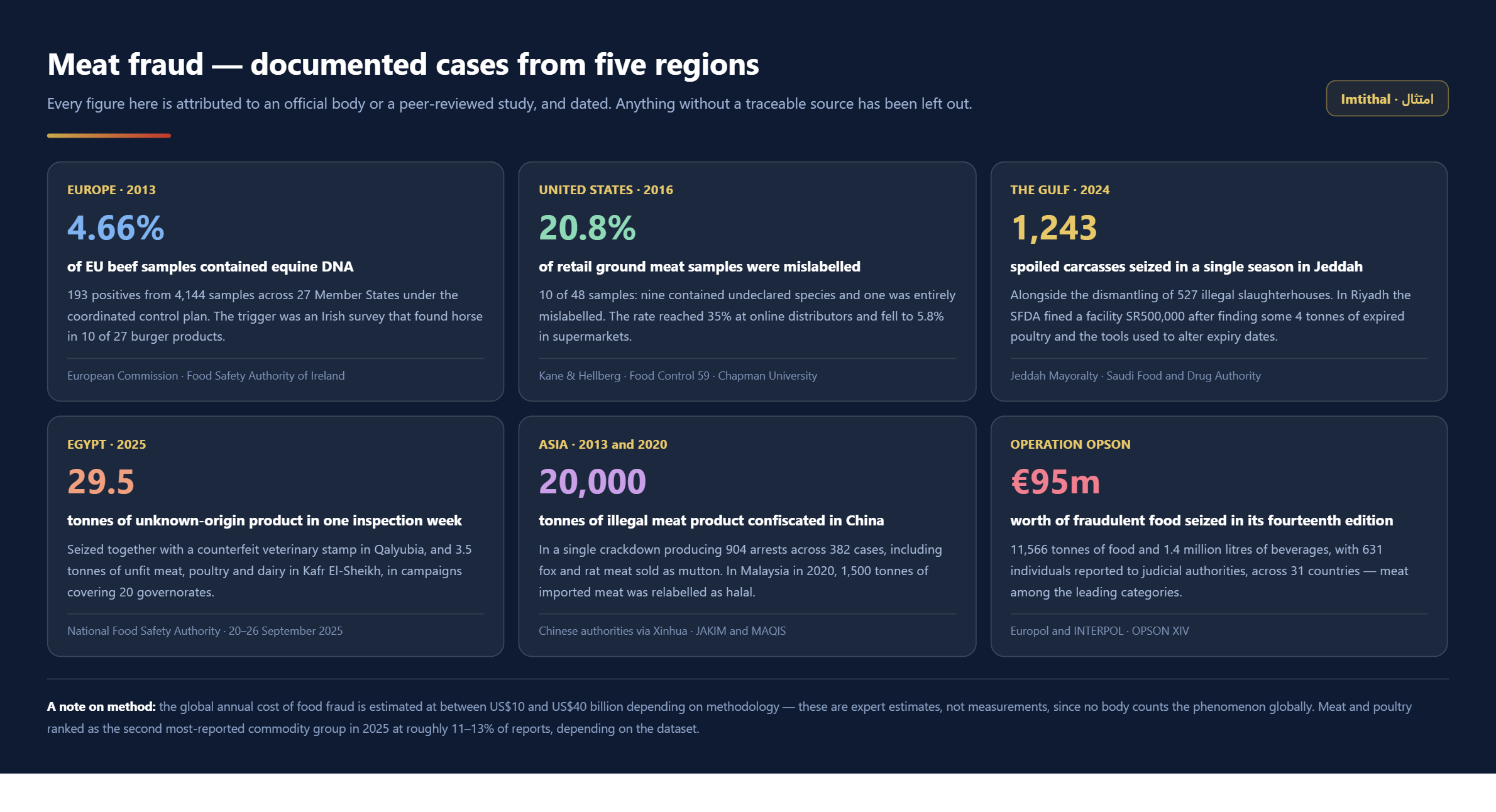
- Fraud usually makes nobody ill — which is why systems built on microbiological safety alone do not catch it, and why it can persist for years before discovery.
- The distribution channel changes the size of the risk: in the US study, mislabelling reached 35% at online distributors against 5.8% in supermarkets.
- A paper document is no guarantee: a counterfeit veterinary stamp was seized in Qalyubia, and the tools for altering expiry dates were seized in Riyadh.
- Halal fraud is a category in its own right, not a subset of species fraud: in Malaysia 1,500 tonnes of imported meat was relabelled with counterfeit halal marks over a period of years.
- The widely quoted global figure — US$40 billion — is an expert estimate, not a measurement. Anyone presenting it to you as settled fact has not read its source.
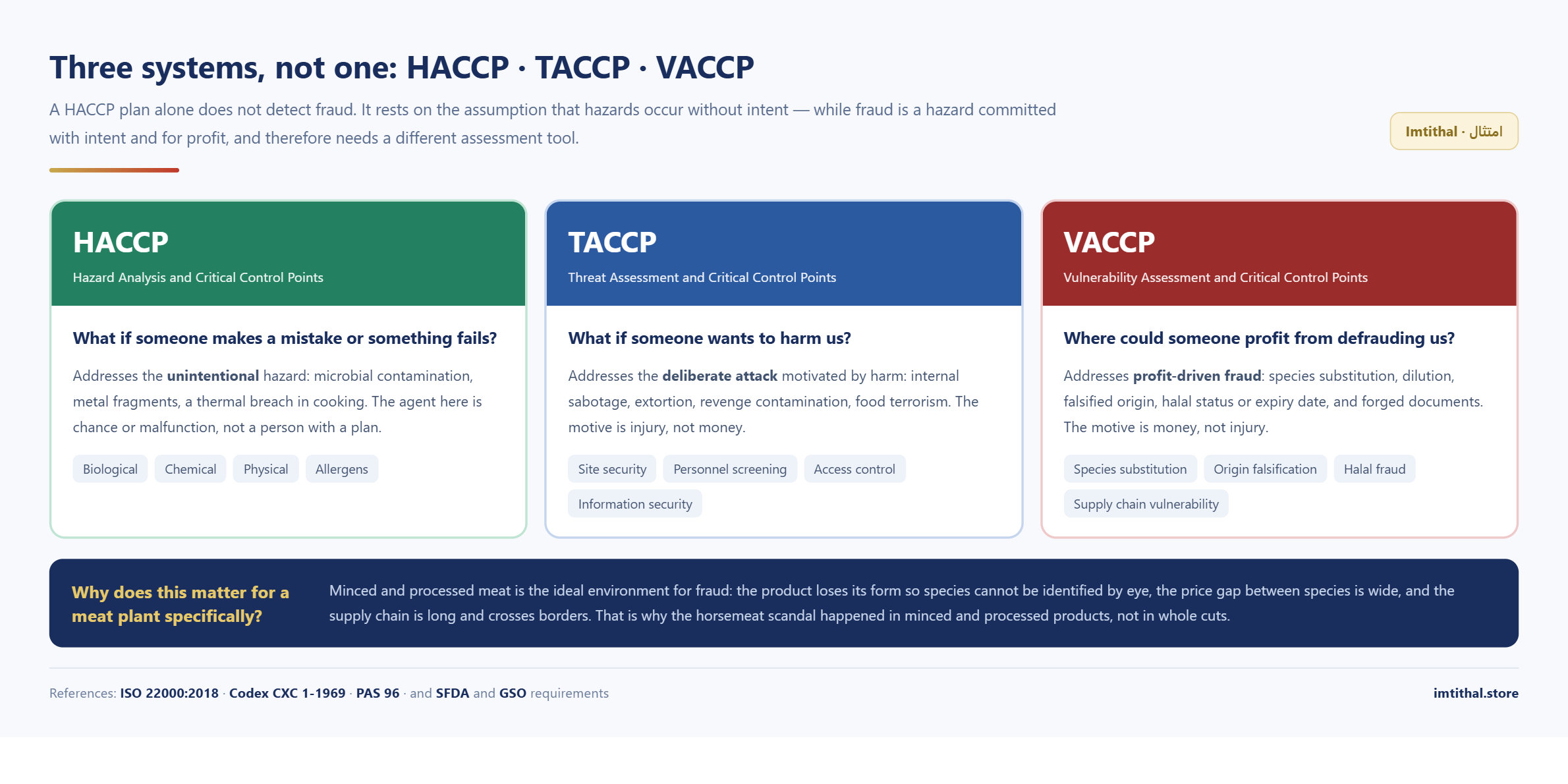
Why does a HACCP plan not detect food fraud?
The answer lies in the definition of HACCP itself. It is a methodology for analysing hazards — and a hazard, in food safety terms, is a biological, chemical or physical agent capable of causing harm to health. The entire method rests on an implicit assumption: that the hazard occurs without intent, through malfunction, chance or negligence.
Fraud is not a hazard in that sense. The actor here is a human being who plans, who knows where the critical control points sit, and who designs the act to pass between them. The horsemeat that entered European burgers was, from a microbiological standpoint, perfectly sound meat. No cooking temperature would have removed it, no microbiological test would have found it, and it would never have appeared in any CCP monitoring record.
This is why two further tools exist alongside HACCP — complementing it rather than replacing it:
What does this mean inside the plant?
Goods-in is the first line of defence
No supplier without documented approval, and no consignment without a certificate of origin, a valid halal certificate and an unbroken temperature record. The supplier matrix records a risk level and a re-assessment frequency for every supplier.
Confirmatory species testing
Periodic PCR testing on finished product and on high-risk incoming materials — the only test that would have detected the horsemeat, and one that no microbiological test can substitute for.
Two-way traceability within hours
From batch number back to supplier, and from supplier forward to every pack despatched. The mock recall exercise measures this in practice against a target of under four hours.
Control the document, do not trust it
Stamps and certificates can be forged, as the cases show. Verification must go back to the issuing source rather than accept a paper copy, and an auditable record must be retained.
A written and reviewed VACCP assessment
Every raw material carries a vulnerability score built from price differential, incident history and chain length — reassessed whenever the market or the supplier changes.
Auditing: seven reference standards on one sheet
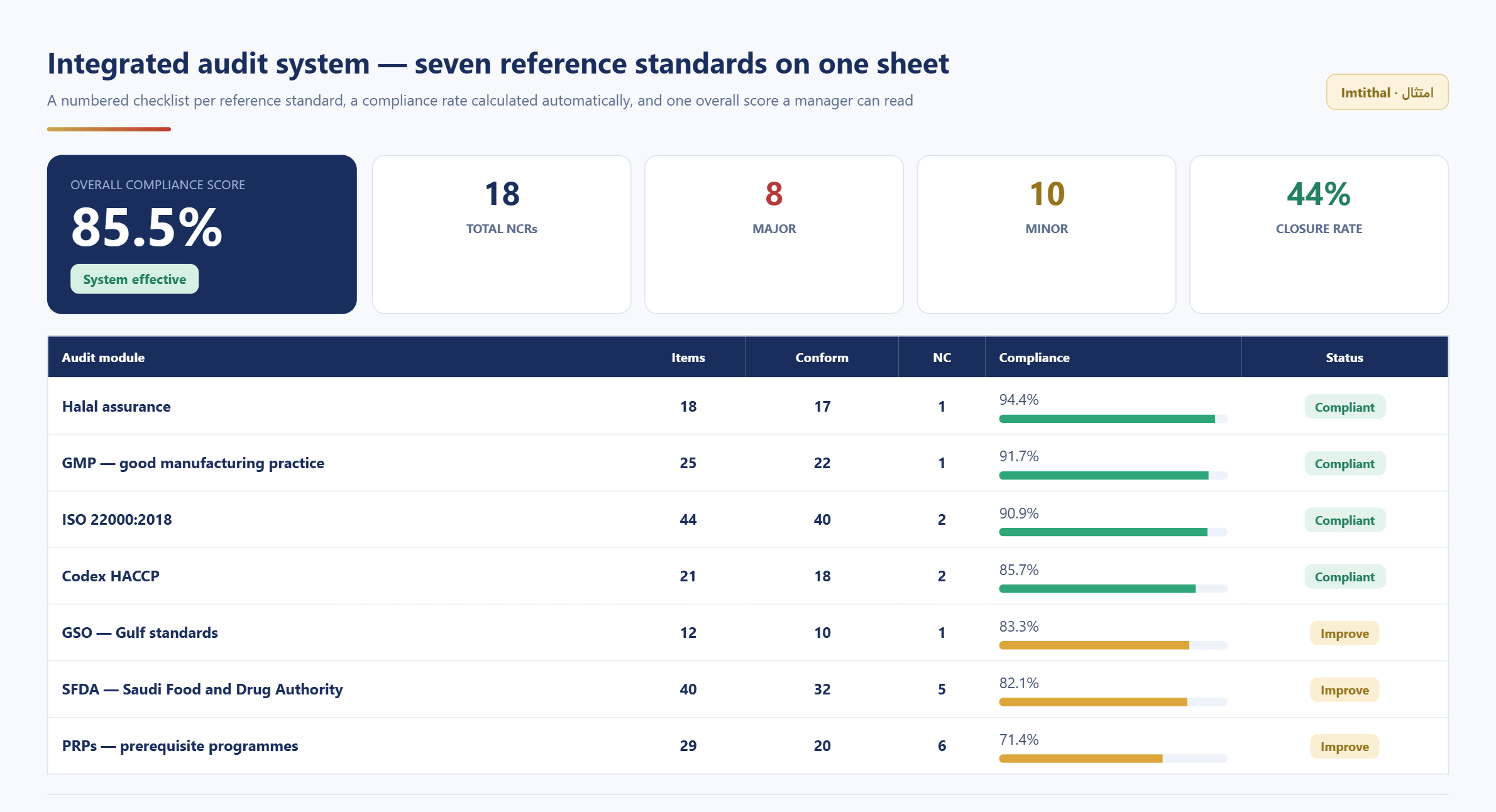
A meat plant in the Gulf answers to more than one authority. There are the Saudi Food and Drug Authority requirements, the GSO standards, ISO 22000 if certification is being sought, the Codex HACCP principles, good manufacturing practice, the prerequisite programmes, and halal assurance. What exhausts quality teams most is that each body arrives with its own separate checklist, so questions repeat and records contradict one another.
The alternative is to build all seven checklists into a single file that calculates a compliance rate per reference standard and one overall score. The plant manager then sees at a glance where the real gap lies — as in the screenshot below from the integrated audit system, where the prerequisite programmes sit at 71% while halal assurance sits at 94%.
From documents to readiness: what the system actually measures
But the count alone does not mean readiness. In the attached implementation tracker, overall progress stands at 74.5% while certification readiness stands at only 58.3% — 14 criteria met out of 24. The gap between those two figures is the distance between "we have written the documents" and "the system works".
Four of the unmet criteria bear directly on our subject: CCP monitoring is not fully operational, non-conformities from the internal audit have not been closed, the facility licence and product registrations need renewal, and the TACCP and VACCP assessments have not been completed. In other words, a plant that looks compliant on paper is still exposed to fraud in particular.
The difference between a documented plant and a safe one is that the first owns the documents, and the second owns the evidence that they work.
Six documents from the system — free download
The attachments below are not illustrative templates. They are six documents from the SafeMeat Pro system itself, under their approved codes, and all of them are bilingual Arabic/English:
- FSMS Implementation Tracker — 111 documents tracked through draft → review → approval → implementation → verification, with a progress dashboard, a phase plan and a 24-criterion readiness checklist.
- FSMS Integrated Audit System — checklists for seven reference standards with a non-conformity log and a calculated scoring dashboard.
- FSMS-HAC-001 — HACCP plan for burgers: product description and flow diagram through hazard analysis, CCP determination and critical limits.
- FSMS-HAC-003 — HACCP plan for hot dogs.
- FSMS-SOP-007 — allergen management procedure: preventing cross-contact, controlling labelling and verifying segregation.
- FSMS-SOP-004 — management review procedure: required inputs and outputs and improvement decisions.
All names and figures in these files are demonstration data and belong to no real facility.
SafeMeat Pro — the complete HACCP and FSMS system for processed meat manufacturing
The fully documented package across nine directories: project plan, quality and food safety manual, standard operating procedures, HACCP plans, prerequisite programmes in a meat-processing edition, forms and records, the internal audit file and regulatory compliance — editable, ready to adopt, and bilingual throughout.
View the complete package